
Scaling Your Gig Without Losing Your Soul


There comes a moment in every successful freelancer’s life when the “hustle” hits a ceiling. You are booked solid. The money is good. Freedom is real. But you are exhausted. You are juggling three major clients, a dozen deadlines, and the gnawing realization that you have become the bottleneck in your own business.
This is the precipice where the gig economy shifts gears. It is the transition from doing the work to leading the work.
In the upcoming book GIGglers GIGgling GIGgles, protagonists Anita and Rahul face this exact tipping point. Overwhelmed by three simultaneous projects—a cosmetics campaign, a wildlife documentary, and a film for a special needs school—they realize that their individual brilliance is no longer enough. To survive and scale, they must evolve from independent contractors into co-founders.
This blog post explores that messy, exhilarating journey. Drawing from their story, we break down the three pillars of scaling up: redefining leadership, building a cohesive crew, and designing a culture that treats conflict as a tool for growth.
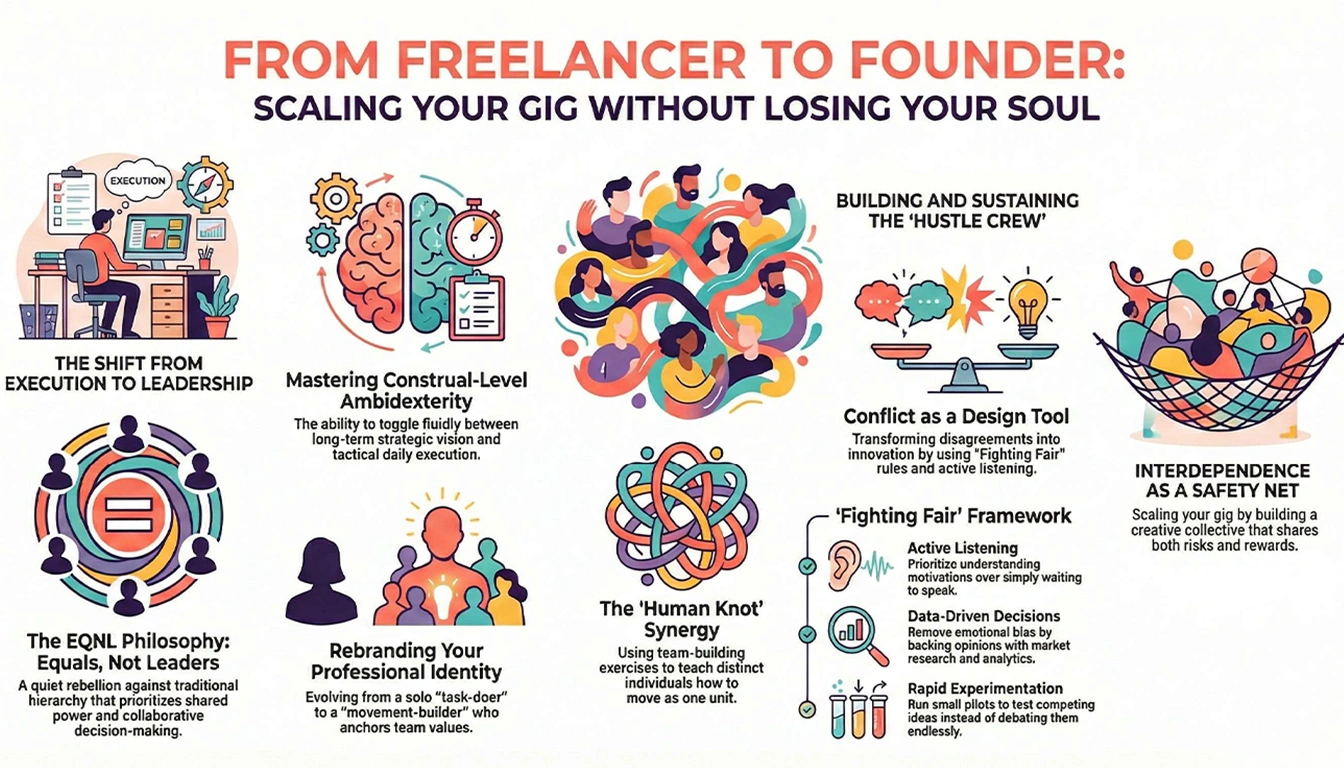
The most dangerous trap for a freelancer-turned-founder is trying to be a "super-freelancer." You try to write every script, edit every frame, and send every invoice because you trust your own execution above all else. But scaling requires a fundamental identity shift.
For Rahul and Anita, this shift crystallizes in the formation of their production house. They don’t want a stiff corporate structure; they want to retain the agility and humanity of the gig life. They name their company EQNL, inspired by a line often attributed to Hemingway: "Aliens look for equals, not leaders."
Equals, Not Leaders is not just a name; it is a manifesto for the modern creative agency. It champions a flat hierarchy where authority comes from competence, not title. However, the book honestly depicts that declaring a flat hierarchy is easier than living it.
The transition is rocky. Rahul, a natural planner who loves spreadsheets and Gantt charts, initially defaults to "boss mode," making payroll decisions and setting contracts without fully consulting Anita. He moves fast, driven by the anxiety of keeping the ship afloat. Anita, on the other hand, feels her voice shrinking. She wonders if she is just a co-founder in name, realizing that "leadership isn't about being the loudest in the room. It's about making sure everyone else is heard".
The lesson for aspiring founders is clear: Leadership in a gig startup is not about command and control; it is about facilitation.
When they finally align, they realize that scaling isn't just about hiring hands to do the work; it's about empowering brains to make decisions. They bring in their trusted collaborators—Sailesh, Anmol, Ajit, Srija, and Akhila—not as subordinates, but as partners in the vision. The shift from execution to leadership happens when you stop hoarding the work and start hoarding the responsibility for the culture that gets the work done.
If leadership is the brain of the new venture, the team is its nervous system. But assembling a "Hustle Crew" in the gig economy is different from corporate hiring. You aren't just looking for skills; you are looking for "Gig Quotient"—adaptability, emotional intelligence, and the ability to thrive in chaos.
In the book, this dynamic comes to life during an impromptu team-building session in Anita’s living room. The founders realize that if they are going to pull off three massive projects with a lean team, they need to move as one unit. They decide to play the "Human Knot"—a game where everyone stands in a circle, grabs the hands of two different people across from them, and tries to untangle the knot without letting go.
The anecdote reveals the diverse personalities that make up a successful gig team:
By the end of the game, the team is laughing, breathless, and physically untangled. But the real breakthrough is psychological. They realize that "we’re not here to be right; we’re here to get it right".
For freelancers building their own teams, the "Human Knot" is a perfect metaphor. You will have introverts and extroverts, planners and improvisers. Your job isn't to force them into a uniform mold, but to help them untangle their differences so they can function as a single, flexible organism. As Rahul notes on their whiteboard debrief, the key takeaways are trust, camaraderie, and problem-solving.
Once you have the leadership philosophy and the team, the final piece of the puzzle is culture. And the true test of culture isn't how you celebrate wins; it's how you handle fights.
In a high-pressure startup environment, conflict is a feature, not a bug. The book illustrates this beautifully in Chapter 13, "Fighting Fair, Growing Together." Before leaving for a high-stakes shoot in Lucknow, Rahul senses simmering tensions. Instead of ignoring them, he calls an impromptu meeting to establish the Rules of Engagement for EQNL.
He frames disagreement not as a threat to the company, but as a "design tool"—a way to sharpen ideas. He writes a list of principles on the soft board that every aspiring founder should pin to their wall:
Anita adds a crucial layer to this framework: Solution-Oriented Conflict. Drawing on her experience as a mother, she emphasizes that we cannot dwell on the problem. "Find a way forward that works for everyone," she advises.
This meeting transforms the team's energy. Ajit, the quiet analyst, perks up at the mention of data. Akhila admits she learns more from their debates than her courses. They realize that in a flat hierarchy like EQNL, safety isn't the absence of conflict—it's the presence of a framework to resolve it.
Transitioning from a freelancer to a founder is less about business registration and more about psychological evolution.
Anita and Rahul’s journey in GIGglers GIGgling GIGgles offers a roadmap that is messy, human, and deeply relatable. They show us that you don't need to become a corporate robot to scale. You can build a company that plays games in the living room, eats thin-crust pizza during strategy sessions, and treats every disagreement as a chance to get better.
You can build a company of equals.
Stay tuned for the next post in this series, where we will explore "The Human Side of the Hustle" and how gig workers navigate parenting, mental health, and community.









In today’s rapidly evolving work landscape, the arrival of Agentic AI in the workplace is shifting the way teams function, decisions...
As artificial intelligence continues to reshape the workplace, a new frontier is emerging-one where human workers and AI agents...

The “Future of Work” is no longer a distant vision—it’s today’s reality. In 2025, global organizations are navigating a landscape...

In a world where distributed teams are the norm rather than the exception, the role of culture is under the microscope like never before...

We hear about AI everywhere - from headlines about job losses to promises of supercharged productivity...

In today's dynamic and often unpredictable business landscape, growth is the ultimate aspiration for small and mid-sized enterprises (SMEs)...