


If there is one thing the modern business world craves, it is consistency. We love it. We build dashboards to track it. We write playbooks to enforce it. In the boardroom, a standardized global engagement strategy looks beautiful. It feels efficient, equitable, and clean. It promises that if we roll out the same values, the same surveys, and the same wellness webinars from London to Singapore, we will get the same output.
It feels like control. But let’s be honest: it is actually an illusion.
As leaders and people managers, we have been sold a lie. We have been told that "fairness" means treating everyone exactly the same. But recent data from inside some of the world’s most complex organizations suggests that this craving for uniformity is actually a primary driver of disengagement. When we treat a complex, multi-cultural, hybrid workforce as a monolith, we don’t just miss the nuances—we actively alienate the people we are trying to lead.
This is not an HR problem. This is a leadership crisis. HR designs the framework, but you—the manager, the team lead, the director - are the one living in the wreckage when that framework fails to fit reality.
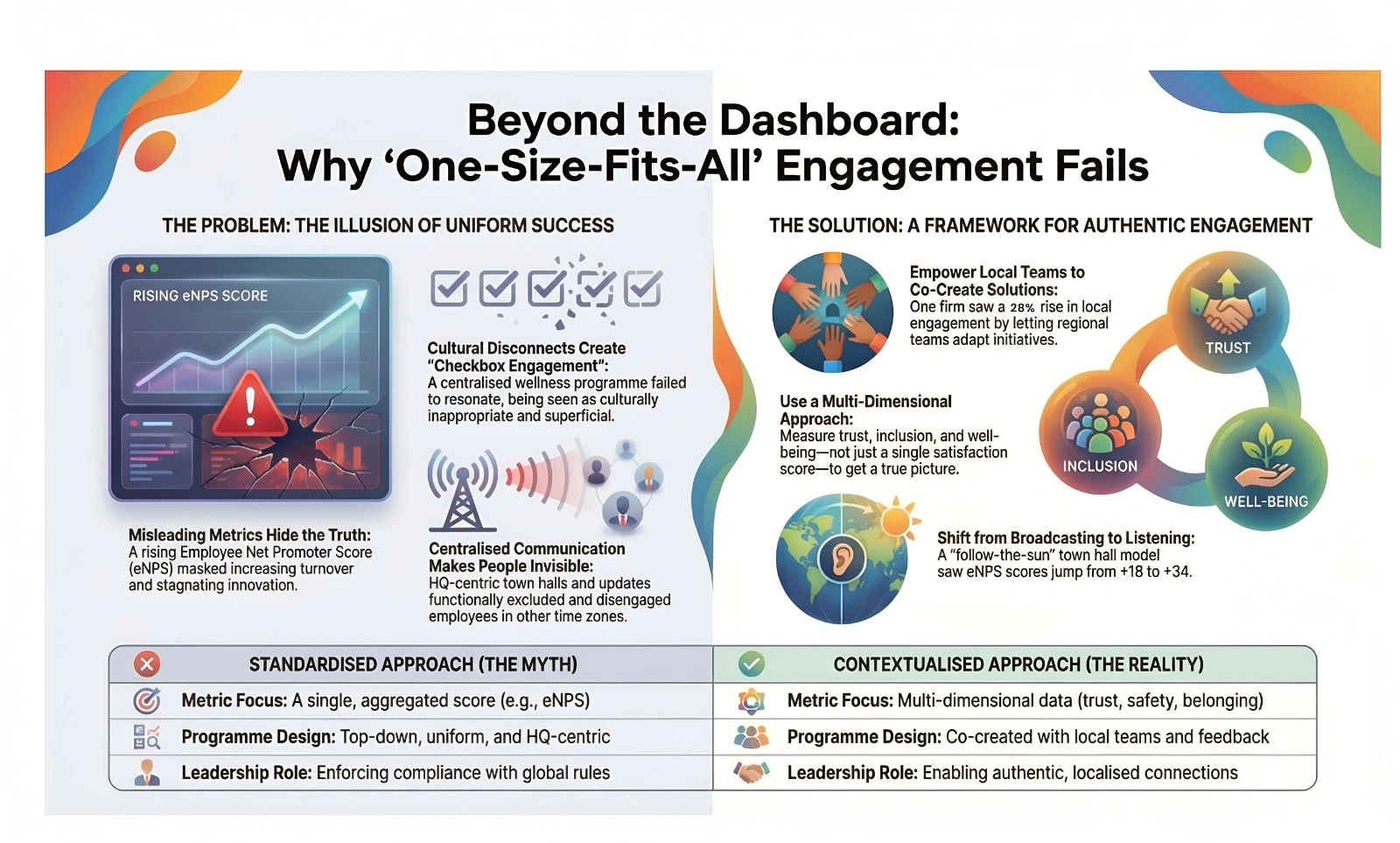
Let’s look at the story of Vertex Dynamics. By all traditional accounts, their managers were winning. For two consecutive quarters, their primary engagement metric—Employee Net Promoter Score (eNPS)—was stable or rising. The dashboard was green. The executives were happy.
But if you were a manager on the ground, the reality felt very different. While the aggregate scores looked healthy, voluntary attrition was quietly climbing in specific, high-value teams. Innovation was stagnating. How could the scores be good if the best people were leaving?
The problem was metric myopia. Vertex fell into the trap of believing that a single, aggregated number could capture the complexity of human experience. By relying on an average, they smoothed over the cracks. The data hid the fact that while the onsite team in New York was thriving, the remote engineers in Bangalore were burning out, feeling isolated and ignored.
As managers, we often hide behind these averages. It is comforting to say, "My team’s engagement score is a 7.8." But an average is a liar. A 7.8 could mean everyone is moderately happy. or it could mean half your team loves you and the other half is updating their CVs.
Vertex learned this lesson the hard way. Their standardized pulse surveys were viewed by remote staff as impersonal "checkbox" exercises. It wasn't until they stopped looking at the single number and started measuring "trust" and "inclusion" at a granular team level that they realized the damage they had done.
The Lesson for Managers: Stop celebrating the average. Your job is not to manage the mean; your job is to manage the variance. If you are looking at a dashboard that tells you everything is fine, but your gut tells you your team is struggling, trust your gut. The "standard" metric is often blind to the specific pain of your people.
The failure of standardization becomes even more dangerous when we try to export "culture" across borders without translation. This is where the story of Synergia Global becomes a warning flare for every global leader.
Synergia launched "PulseConnect," a massive, centralized engagement program designed at headquarters. It had everything a modern corporate program is supposed to have: wellness webinars, virtual recognition badges, and standardized surveys.
On paper, it was a success. Global participation hit 78%. HR marked it as a win. But within nine months, the managers in Southeast Asia and Eastern Europe were dealing with a retention crisis. Exit interviews revealed that the local teams viewed the headquarters-designed initiatives as performative and culturally tone-deaf.
Consider the "Speak Up" campaign Synergia tried to roll out. In a low-context, individualistic Western culture, encouraging employees to challenge leadership openly is seen as empowering. But in a high-context Asian culture where hierarchy carries a different weight and respect is demonstrated through deference, demanding that employees "speak up" without first establishing deep psychological safety felt aggressive and unsafe.
Furthermore, the "standardized" wellness webinars failed because they assumed a certain type of lifestyle. A virtual yoga session at 5 PM might work for a manager in a spacious home office in San Francisco. It fails miserably for a regional team member working from a shared multi-generational home with limited bandwidth.
The Lesson for Managers: You are the filter. HR provides the menu, but you must curate the meal. If you take a corporate initiative and force-feed it to your team without contextualizing it for their culture, their time zone, and their reality, you are not engaging them. You are insulting them. Synergia only fixed this when they empowered local leaders to co-design the programs—keeping the core values (the "why") but changing the execution (the "how").
Perhaps the most insidious form of standardization today happens in the hybrid workspace. We assume that because everyone has Zoom, everyone has equal access. This is the fallacy of SkyTrek Logistics.
SkyTrek transitioned to a hybrid model and "standardized" their town halls and communication flows. But they standardized them based on Headquarters' preferences. The town halls happened when it was convenient for the C-suite. The newsletters were written in the idiom of the home office.
The result was a massive "Visibility Gap." Employees in regional offices in South Asia and Latin America felt functionally invisible. They weren't disengaged because they hated the company; they were disengaged because the company’s "standard" operating procedure made them second-class citizens.
This isn't just about time zones; it’s about power. When we standardize communication to the "center," we marginalize the "edge."
If you manage a distributed team, ask yourself: Who holds the power in your meetings? Is it the people in the room with you, or is it equally distributed to the faces on the screen? SkyTrek’s managers found that regional teams were checking out—ignoring the town halls and deleting the newsletters. They only turned the ship around when they moved to a "follow-the-sun" model, where regional leaders took turns hosting global events, and communications were translated not just linguistically, but culturally.
The Lesson for Managers: Proximity bias is real, and standardization feeds it. If you treat your remote employees exactly the same as your in-office employees without accounting for the distance, you are failing them. You cannot manage a person you cannot see using the same tools you use for the person sitting next to you.
So, what do we do? We cannot simply throw out all the rules and let chaos reign. But we must fundamentally shift our role as managers. We need to stop being the Enforcers of Standardization and start being the Translators of Context.
The case studies of Vertex, Synergia, and SkyTrek,, collectively teach us three critical pivots for any people manager:
1. Reclaim Your Autonomy (The "How" vs. The "Why") Your organization sets the mission (the "Why"). HR sets the policy (the "What"). But you own the "How." When Synergia moved to a decentralized model, they didn't stop doing engagement. They just stopped mandating how it looked. They allowed local "Pulse Panels" to decide what engagement meant for them.
• Action: Next time a generic initiative comes down the pipe, ask yourself: "How does this land with my specific team?" If it doesn't fit, don't just roll it out. Adapt it. Translate it.
2. Measure the Silence, Not Just the Noise Vertex Dynamics was fooled by eNPS because they only looked at the people who were talking. They missed the "silent resignation" of those who had already checked out.
• Action: Don't wait for the annual survey. Look at the digital body language of your team. Who has stopped turning on their camera? Who has stopped joking in the Slack channel? That silence is a louder data point than any engagement score.
3. Democratize the Design The biggest mistake SkyTrek made was assuming that Headquarters knew best. The moment they asked regional leaders to host the town halls, engagement skyrocketed.
We have spent the last decade trying to engineer the human out of human resources. We have tried to turn engagement into a formula, a metric, a dashboard. We did this because we thought it would be efficient.
But efficiency with things is different from effectiveness with people. You can be efficient with a spreadsheet. You cannot be efficient with a relationship.
The organizations in these case studies—Vertex, Synergia, SkyTrek—all failed when they tried to scale intimacy through standardization. They succeeded only when they remembered that engagement happens in the specifics. It happens in the unique culture of a local office, in the specific dynamics of a hybrid team, and in the individual career aspirations of a human being,.
As a manager, you are the guardian of that specificity. Do not let the dashboard blind you to the reality of your people. Do not let the "standard process" become an excuse for lazy leadership.
Real alignment doesn't mean everyone does the same thing. It means everyone feels the same sense of belonging, regardless of how they got there. And creating that feeling? That is your job.
Based on case studies from Vertex Dynamics, Synergia Global, and SkyTrek Logistics.








In today’s rapidly evolving work landscape, the arrival of Agentic AI in the workplace is shifting the way teams function, decisions...
As artificial intelligence continues to reshape the workplace, a new frontier is emerging-one where human workers and AI agents...
The “Future of Work” is no longer a distant vision—it’s today’s reality. In 2025, global organizations are navigating a landscape...

In a world where distributed teams are the norm rather than the exception, the role of culture is under the microscope like never before...

We hear about AI everywhere - from headlines about job losses to promises of supercharged productivity...

In today's dynamic and often unpredictable business landscape, growth is the ultimate aspiration for small and mid-sized enterprises (SMEs)...