
Why the "Future of Work" Is Crushing Your Middle Managers
In every organization, there is a choke point. Strategy comes down from the C-suite- clean, ambitious, and optimistic. Reality bubbles up from the frontline—messy, urgent, and complex. They meet in the middle. They meet at the manager.
We have always expected our managers to be superheroes. We ask them to hit operational KPIs, manage budgets, and deliver projects on time. But in the post pandemic era, we have quietly added a massive new layer of responsibility to their job descriptions: they must now be therapists, career coaches, culture carriers, hybrid work coordinators, and Chief Engagement Officers.
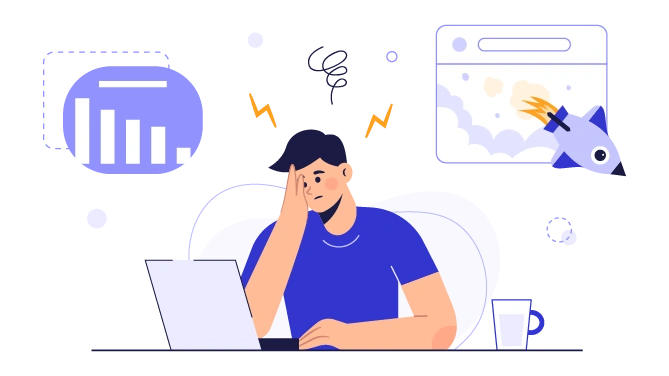
We call this the "Hourglass Effect". The pressure from the top and the pressure from the bottom are squeezing the middle to a breaking point.
As leaders, we often talk about "Employee Experience" (EX). But we rarely talk about "Manager Experience." And the data from recent case studies like Northwell Logistics and InventaCore Systems reveals a frightening truth: we are burning out the very people we rely on to fix burnout.
This is not an HR problem. HR writes the policies, but you—the operational leader—are the one who has to look a burnt-out team member in the eye and ask for "one more push." If you are managing managers, or if you are a manager yourself, you need to understand that you cannot build a culture of engagement on the backs of exhausted leaders.
Northwell Logistics provides a perfect autopsy of this crisis. Facing a booming e commerce market, they did what many growing companies do: they promoted their best technical experts into management roles. These were people who knew how to run a warehouse, how to optimize a supply chain, and how to get boxes out the door.
Then, the company layered on the "soft" stuff. HR rolled out wellness mandates, engagement pulse surveys, and requirements for empathetic check-ins.
The result wasn't a better culture; it was a collapse. The managers were drowning. They had dual burdens: deliver the numbers (which hadn't changed) and "make the team happy" (which was a new, undefined KPI). Without structural support or training in these new human-centric skills, they went into survival mode.
And here is the critical lesson for every leader: Burned-out managers cannot offer psychological safety. They cannot offer empathy. When a manager is in survival mode, they don't have the emotional bandwidth to listen to a team member’s career aspirations or personal struggles. They just want the shift to end.
At Northwell, the cost was a 28% surge in frontline turnover. The employees weren't leaving the company; they were leaving their stressed-out bosses. As the McKinsey Health Institute (2023) points out, manager burnout is not a personal flaw—it is a systemic business risk. If you keep piling straw on the camel's back, don't blame the camel when it breaks. Blame the person loading the straw.
The Lesson for Leaders: You cannot add "Engagement Champion" to a manager's job description without taking something else away. If you want your managers to lead with empathy, you must audit their administrative burden. You must automate the mundane so they have time for the human.
When managers are stressed, untrained, and managing people they can’t see (thanks to hybrid work), they rarely default to trust. They default to control.
This was the failure at InventaCore Systems. Faced with a transition to hybrid work and immense pressure to maintain productivity, managers found themselves in a bind. They didn't know how to measure output, so they tried to measure activity.
They fell into what Microsoft calls "Productivity Paranoia". Managers started checking "green dot" status on chat apps to track attendance. They installed monitoring software. They demanded constant updates.
This wasn't because these managers were evil. It was because they were unprepared. No one had taught them how to lead by outcomes rather than observation. In the absence of skill, they reverted to surveillance.
The impact was catastrophic. This "green dot management" destroyed trust faster than any wellness perk could build it. High-potential talent in R&D and design—people who need autonomy to be creative-fled the company. They refused to work for bosses who treated them like untrustworthy teenagers.
The Lesson for Leaders: Micromanagement is often just a symptom of a manager who feels out of control. If you see your managers hovering, don't just scold them. Ask them: "Do you have the tools to measure results?" If the answer is no, you have failed them. You cannot ask a manager to trust a remote team if you haven't given them the metrics to verify performance without spying.
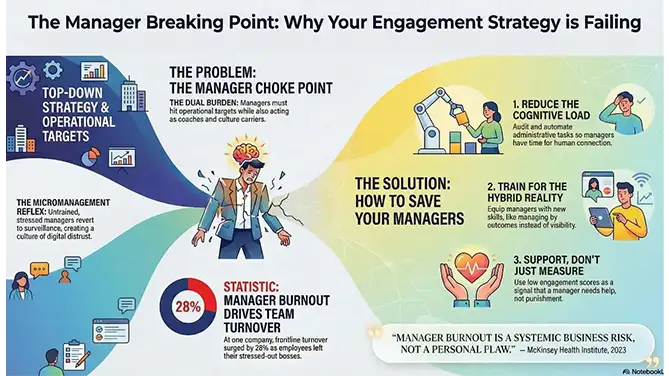
So, how do we stop breaking our managers? The companies that turned this around— Northwell and InventaCore—didn't just ask more of their managers; they gave more to them.
1. Treat Soft Skills as Hard Skills Northwell Logistics
stopped assuming that a good
logistics expert would naturally be a good people leader. They adopted a "People
Manager Essentials" model (similar to Unilever). They realized that empathy, conflict
resolution, and resilience are not innate traits; they are professional skills that must be taught.
• Action: Stop promoting people solely based on technical competence. If you promote a top performer to manager, you are often losing your best player to gain a mediocre coach. Train them before you blame them.
2. The "Oxygen Mask" Principle
You know the airline safety rule: "Put on your own
oxygen mask before assisting others." You cannot expect a manager to care for their
team's well-being if they are suffocating. Northwell introduced "Manager Reset
Days"-time off specifically for leaders to decompress. They acknowledged that
leading people is emotionally draining work. By giving managers permission to
disconnect, they restored the emotional reserves needed to lead effectively.
• Action: Look at your managers' calendars. Are they back-to-back from 8 AM to 6 PM? If they have no white space, they have no capacity for leadership. They only have capacity for administration.
3. Leading Without Hovering InventaCore tackled the trust issue by running "Leading
Without Hovering"
workshops. They taught managers how to set clear expectations
(Outcomes) so they could stop worrying about the process (Hours). They audited
leadership behaviors to catch micromanagement early and coached against it.
Action: Shift the conversation from "Where are you working?" to "What are you delivering?" If the work is good, the location (and the green dot) shouldn't matter.
We need to fundamentally reframe how we view middle management.
Your middle managers are the immune system of your organization. They fight off toxicity. They metabolize the stress coming from above so it doesn't crush the team below. They nurture growth. They keep the body functioning.
But right now, in many companies, the immune system is compromised. We have overworked it, under-resourced it, and undervalued it.
As a leader, your most critical job is not to manage the frontline. Your job is to enable the people who manage the frontline. Stop treating managers as the delivery mechanism for your strategy and start treating them as the most critical stakeholders in it.
If they fall, the strategy falls with them.
If you want to save your culture, save your managers first.








In today’s rapidly evolving work landscape, the arrival of Agentic AI in the workplace is shifting the way teams function, decisions...
As artificial intelligence continues to reshape the workplace, a new frontier is emerging-one where human workers and AI agents...

The “Future of Work” is no longer a distant vision—it’s today’s reality. In 2025, global organizations are navigating a landscape...

In a world where distributed teams are the norm rather than the exception, the role of culture is under the microscope like never before...

We hear about AI everywhere - from headlines about job losses to promises of supercharged productivity...

In today's dynamic and often unpredictable business landscape, growth is the ultimate aspiration for small and mid-sized enterprises (SMEs)...