
Why Your Best People Leave Without Saying a Word

In the old world of work, disengagement had a physical form. As a manager, you could see it. It looked like the slumped shoulders in the Monday morning meeting. It was the long lunch break that stretched into two hours. It was the silence in the conference room when you asked for volunteers, or the way a usually energetic team member started arriving ten minutes late, coffee in hand, eyes averted.
You didn't need a survey to know something was wrong. You just needed eyes.
But in the hybrid era, disengagement has become invisible. It hides behind a turned-off camera. It masks itself in a delayed Slack response. It looks like a "green dot" on a status bar that says Available, even when the human being behind it has emotionally checked out months ago.
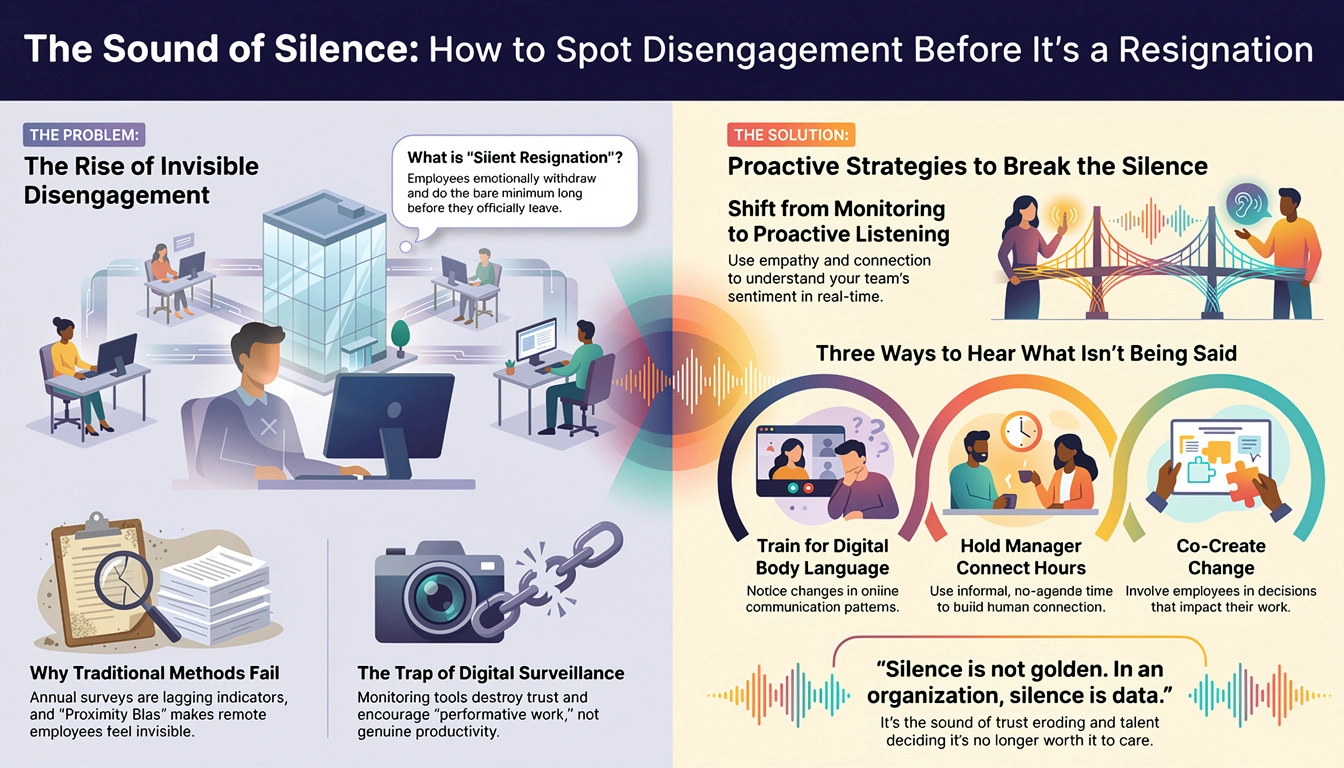
We call this "Silent Resignation." It is the phenomenon where employees withdraw their emotional investment long before they withdraw their labor. And for the modern people manager, it is the single most dangerous threat to your team’s stability.
The terrifying reality revealed in recent organizational case studies is that the tools we rely on to detect this—annual engagement surveys and formal reviews—are failing us. They are lagging indicators. By the time the data tells you someone is unhappy, they have already signed an offer letter with your competitor.
This is not a problem that HR can solve with a better questionnaire. This is a leadership crisis. As managers, we have lost our radar. And if we don't learn to "hear" the silence, we will continue to be blindsided by the exits of our best talent.
To understand how dangerous this silence is, we must look at the case of Orion TechWorks.
In 2024, Orion looked like a hybrid success story. They had 5,000 employees distributed across three continents. Their collaboration tools were cutting-edge. And most importantly, their bi-annual engagement scores were solid. Leadership believed they had cracked the code on the "future of work."
But in the middle of the year, a tremor hit the company. Voluntary attrition spiked by 20%, specifically targeting their mid-career professionals in hybrid roles.
The managers were shocked. "But their survey scores were fine," they said. "They never complained in our 1:1s."
When HR conducted the exit interviews, a different story emerged. These employees hadn't quit because of a sudden event. They had quit because of a slow, creeping invisibility. They cited "lack of growth," "feeling disconnected from leadership," and simply "feeling invisible."
Orion had fallen victim to Proximity Bias. Leaders naturally directed their energy, feedback, and informal mentorship toward the people they physically saw in the office. The remote and hybrid employees, sensing they were becoming second-class citizens, didn't storm into the boss's office to complain. They didn't start a revolution. They simply stopped caring.
They did the bare minimum to keep their jobs (the "green dot" game) while using their energy to look for new ones. They became ghosts in the machine.
The Lesson for Managers: Do not mistake silence for contentment. In a hybrid world, silence is often the sound of someone deciding that you are no longer worth the effort of a difficult conversation. If your remote high-performer has stopped challenging you, stopped joking in the chat, or stopped offering new ideas, they aren't "settled." They are leaving.
When managers realize they have lost visibility, their instinct is often to force it back. If we can't see them working, we will track them working.
This is what happened at InventaCore Systems. Faced with the "black box" of remote productivity, managers panicked. They didn't know how to measure outcomes, so they tried to measure activity. They rolled out monitoring software. They tracked login times. They obsessed over how long a user’s status remained "Active" on messaging apps.
This reaction is what Microsoft calls "Productivity Paranoia". And it is fatal to engagement.
At InventaCore, the message received by employees was clear: I don't trust you. And when you break trust, you break engagement. The result wasn't increased productivity; it was increased "performative work." Employees started jiggling their mouse cursors to stay "green" while watching Netflix or, more likely, updating their LinkedIn profiles.
This surveillance didn't just fail to catch disengagement; it accelerated it. It created a "culture of digital distrust." High-potential talent—the people who value autonomy the most—were the first to leave. They refused to work for leaders who treated them like teenagers.
The Lesson for Managers: You cannot spy your way to engagement. Digital surveillance is a substitute for leadership. If you have to check a log to see if your employee is working, you have already failed to set clear expectations. You are managing hours, not outcomes. And in the knowledge economy, hours are irrelevant. Value is what matters.
Sometimes, the silence isn't about the individual; it’s about the system we build around them.
Consider Zenexa Health Systems. During a massive digital transformation, leadership communicated constantly. They held town halls. They sent newsletters. They released videos. It was a broadcasting blitz.
But it was all one-way. The frontline staff—nurses and administrators—were excluded from the design process. They saw flaws in the new plan, but because there was no meaningful channel for feedback, they said nothing.
Silence became a survival mechanism. Why speak up if no one is listening?
When the rollout inevitably hit snags, the frontline didn't help fix it. They watched it burn. Turnover surged by 35% in critical roles. Exit interviews revealed the core sentiment: "Decisions were made over our heads."
AxionWave Industries found a similar dynamic regarding diversity. They had "Inclusion Days" and dashboards, but their marginalized employees—LGBTQ+ staff, ethnic minorities—were the most silent group in the company. Why? Because they feared that speaking up about microaggressions or bias would label them as "difficult." They didn't have Psychological Safety. They had "safe spaces" that weren't actually safe.
The Lesson for Managers: Silence is a learned behavior. If your team is quiet during a change initiative, or if your diverse talent is silent during an inclusion meeting, it is because they have learned that their voice has no value—or worse, that it carries a penalty.
So, if we can't trust the annual survey, and we can't use surveillance software, how do we break the silence? How do we spot the resignation before it happens?
The organizations that turned this around—Orion, Zenexa, and others—did so by shifting from Passive Measurement (waiting for a survey) to Proactive Listening (hunting for the signal).
Here are three shifts every people manager needs to make today:
1. Master "Digital Body Language"
At Orion TechWorks, they trained managers to stop looking for physical cues and start looking for digital ones.
As a manager, you must be a student of these patterns. When the pattern breaks, don't wait. Reach out. Not with a "Where is that report?" email, but with a "I've noticed you seem a bit different lately, is everything okay?" call.
2. Create "Agenda-Free" Space
Efficiency is the enemy of connection. In a remote world, every meeting has an agenda. Every Zoom call has a hard stop. We have eliminated the "in-between" moments where humans actually connect. Orion introduced "Manager Connect Hours." These were unscripted, agenda-free blocks of time where the only goal was human connection. No status updates allowed. This is where the real data surfaces. This is where you hear about the sick parent, the frustration with the new software, or the boredom with the current project. You cannot detect burnout in a status meeting. You can only detect it in the margins.
3. Make "Voice" a KPI
Bravura Financial Services realized that if they wanted people to speak up, they had to measure safety, not just "satisfaction." They started asking a specific question: "Do you feel safe to challenge the status quo without fear of negative consequences?" They made this a metric for leadership success. Zenexa solved their silence by launching "Change Champion Networks." They brought the frontline into the design room. When people help build the ship, they don't drill holes in the hull.
The Lesson for Managers: Don't just ask "Do you have any questions?" at the end of a call (which invites silence). Ask specific, provocative questions: "What is one thing about this new process that is going to annoy you?" "If you were me, what would you change about how we ran this project?" Give them permission to be critical.
The exit interview is an autopsy. It tells you exactly why the relationship died, but it is too late to save the patient.
Too many managers are waiting for the autopsy. They are relying on HR to send them a report saying their team is disengaged. But in a hybrid world, by the time that report hits your inbox, the silence has already solidified into a resignation letter.
Silence is not golden. In an organization, silence is data. It is the sound of trust eroding. It is the sound of your best talent deciding that it is simply not worth the energy to care anymore.
Your job as a manager is to break that silence. It is to look for the absence of signal, not just the presence of it. It is to create spaces brave enough for the truth to be spoken. As recent insights from Harvard Business Review highlight, effective leaders today must build tolerance for uncertainty and move away from hovering toward empowering outcomes—exactly what prevents the kind of silent disengagement we're seeing.
Don't wait for them to tell you they are leaving. Listen to the whispers now, so you don't have to deal with the shock later.
Based on case studies from Orion TechWorks, Zenexa Health Systems, InventaCore Systems, Bravura Financial Services, and AxionWave Industries.



Organizations operating in distributed, high-volume, or high-variability environments, such as HR shared services...

As the digital landscape evolves, data-powered organizations are gaining a competitive edge. Data has become the new currency...

The world of work is evolving at an unprecedented pace, and outplacement and workforce transition consulting...

The workplace is rapidly evolving at an unprecedented pace. As organizations navigate a landscape increasingly influenced by artificial intelligence...

Artificial Intelligence (AI) isn’t just some sci-fi fantasy anymore—it’s really changing the way companies work today...

In today’s fast-paced business world, People Analytics is reshaping the way organizations attract, engage, and retain talent...