
The Gig Worker’s Toolkit

3 Essential Strategies to Survive and Thrive


The Gig Worker’s Toolkit: 3 Essential Strategies to Survive and Thrive

  •   Abhinandan Mookherjee
  •   Feb 20, 2026

Introduction

If the corporate world is a highway with clear lanes and speed limits, the gig economy is an off-road rally. The terrain shifts constantly. One day you are a strategist in a boardroom; the next, you are a troubleshooter on a film set, or a ghostwriter facing a midnight deadline. There are no HR manuals, no fixed hours, and often, no safety net.

So, how do you not just survive the ride but actually enjoy it?

In the upcoming book GIGglers GIGgling GIGgles, authors Sujitesh Das and Abhinandan Mookherjee explore this question through the lives of Anita and Rahul—two professionals who have traded job titles for autonomy. Their journey reveals that success in this new world doesn't just rely on technical skills. It relies on a specific "Gig Quotient" (GQ)—a toolkit of mental and behavioral strategies that turn chaos into a career.

This post breaks down three practical, "how-to" strategies from their story: The Chameleon Principle, Construal-Level Ambidexterity, and Proactive Curiosity. Whether you are a freelancer, a consultant, or a side-hustler, these are the tools you need in your kit.

Strategy 1: The Chameleon Principle (Social Agility)

In the gig economy, you rarely have the luxury of a single "work persona." You are constantly moving between different clients, cultures, and expectations. One client might value formal emails and rigid hierarchies; another might prefer WhatsApp voice notes and late-night brainstorming.

Anita, a seasoned writer and editor in the book, calls this The Chameleon Principle.

The core competency here is Social Agility—the ability to adapt your communication style and behavior to fit the environment without losing your authenticity. As Anita explains to her younger mentees, Akhila and Srija: "A gig worker is like a chameleon. We change our colors to blend into different environments".

How to Apply It:

  1. Decode the Client’s Language: When you start a new gig, listen before you speak. Does the client use corporate jargon or casual slang? Do they value brevity or detailed storytelling? In the book, Anita pivots from writing academic textbooks to drafting punchy commercial scripts for a cosmetics brand. She doesn't write a script like a textbook. She adapts. She realizes that a startup founder needs a partner who moves fast, while an academic publisher needs someone who is meticulous. Matching your client’s "language" builds instant rapport.
  2. Build "Relational Equity": Being a chameleon isn't about being fake; it's about being relatable. Anita shares a story of working with a startup founder where she delivered quality work and clear communication. That reliability turned a single project into a steady stream of referrals. In the absence of a brand name, you are the brand. Your ability to fit into a client's team—to make them feel like you are one of them—is what gets you rehired.
  3. The "Support without Sermons" Approach: When mentoring her juniors, Anita notices they are struggling. Instead of acting like a distant boss, she shifts her persona to that of a supportive mentor. She invites them for chai, shares her vulnerabilities, and teaches them practical habits. She reads the room. If she had used a corporate "performance review" style, she would have alienated them. Instead, she used empathy to unlock their potential.

The Takeaway: Don’t be rigid. Be fluid. The most successful gig workers are those who can walk into any room (or Zoom call) and make the client feel, "They get us." Adaptability in communication is key for freelancers thriving in diverse environments — see the chameleon approach to global teams.

Strategy 2: Managing the Chaos (Construal-Level Ambidexterity)

If you ask Rahul, the filmmaker protagonist, about his day, it sounds like a logistical nightmare. He juggles high-stakes shoots, client pitches, and the intense demands of being a single father and a caregiver to ailing parents. How does he keep the lights on without burning out?

He masters Construal-Level Ambidexterity.

This is a fancy term for a simple but powerful concept: the ability to zoom out to the big picture (strategy) and zoom in to the details (execution). Most people are good at one or the other. Gig workers must be good at both, often simultaneously. This capability is highlighted in research as essential for thriving in the gig economy — Ashford et al. (2018) on construal-level ambidexterity for gig workers.

How to Apply It:
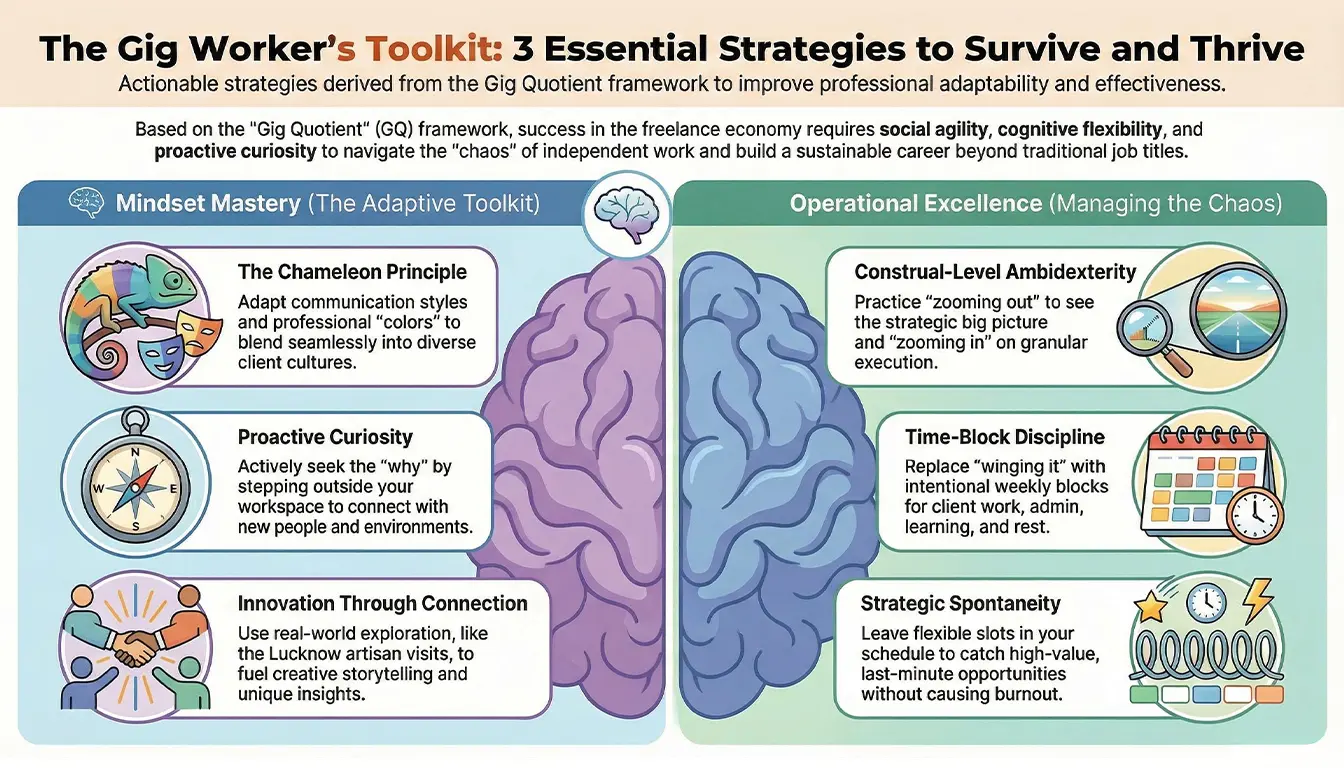
  1. The Zoom-Out: The Strategic View When Rahul helps form their production company, EQNL (Equals, Not Leaders), he is in "zoom-out" mode. He looks at the long-term vision: building a flat hierarchy, creating a culture of trust, and ensuring the company values align with their personal lives. He isn't worried about which camera lens to use; he is worried about the why of the business.
    Actionable Tip: Dedicate time each week to "Zoom Out." Don't just do the work; look at your trajectory. Are your current projects leading you toward your financial and personal goals? If not, pivot.
  2. The Zoom-In: The Execution View However, a vision doesn't pay the bills. Execution does. When a shoot in Lucknow goes sideways because a cameraman is late, Rahul immediately zooms in. He deals with logistics, manages emotions, and coordinates with his assistant, Anmol, to solve the immediate crisis. He becomes hyper-focused on the details: the lighting, the schedule, the interpersonal dynamics on set.
    Actionable Tip: Use "Time Blocking" to manage the zoom-in. Anita teaches her team to block out specific hours for deep work (writing/editing) and separate blocks for admin (invoices/emails). When you are in a block, be fully in it.
  3. The Pivot: Switching Gears The real skill is the switch. In Chapter 1, we see Anita feeding her toddler while mentally prepping for a client call. She switches from "Mom" to "Professional" in seconds. This cognitive flexibility is the hallmark of a high Gig Quotient.
    Actionable Tip: Create rituals to help you switch gears. It could be as simple as changing your clothes, moving to a different chair, or, like Anita, using a specific notebook for work tasks. Train your brain to recognize when it’s time to zoom in and when it’s time to zoom out.
Read Also : The Human Side of the Hustle: Parenting, Crisis, and the Safety Net of Community

Strategy 3: Creativity Over Kebabs (Proactive Curiosity)

In a world dominated by AI and automation, what is the one thing a gig worker brings that a machine cannot? Curiosity.

The book illustrates this beautifully in Chapter 17, titled "Creativity over Kebabs". Rahul’s team—Anmol and Nisha—are driving back from a shoot in Lucknow. They could have just scrolled through their phones. Instead, they stop at a village.

They don't have a brief. They don't have a client asking for this. They just have Proactive Curiosity—the drive to seek out new experiences and connect the dots.

How to Apply It:

  1. Step Outside the Office (Literally and Metaphorically): Nisha and Anmol walk into the village and start talking to locals. Nisha connects with women stitching chikankari patterns. She holds a baby; she shares tea. She isn't extracting content; she is building a connection. This experience gives them a deeper understanding of the culture, which eventually fuels their storytelling.
    Actionable Tip: Don’t let your input come solely from Google. Go to a museum, talk to a stranger, take a different route home. Innovation happens when you collide with the real world.
  2. Connect the Unconnected: Later that evening, over a meal of Tunday Kebabs, Rahul explains to Anmol that this curiosity is a professional asset. He calls it "Proactive Curiosity". It’s about not settling for the status quo. By engaging with the village artisans, the team found a new angle for a potential story that they wouldn't have found in a boardroom.
    Actionable Tip: Keep a "Curiosity Journal." Write down interesting things you see or hear that have nothing to do with your current work. Review it when you are stuck. You'll be surprised how a conversation with a village artisan can inspire a corporate campaign.
  3. Build "Human" Data: In the gig economy, data is important, but emotional data is priceless. When the team had to edit the final documentary, they realized they needed more emotional weight. Because they had built relationships and remained curious, they were able to quickly get additional interviews with caregivers. Their curiosity had built a reservoir of goodwill they could tap into when the pressure was on.

The Takeaway: Don't just be an expert in your field; be a student of the world. As Rahul tells his team, "People like Nisha don't settle for the status quo. They are always asking questions... That's what sets them apart". Proactive curiosity drives creativity and opportunity in dynamic work like freelancing — proactive curiosity as new job security.

Conclusion: Your GQ is Your Safety Net

The gig economy can feel isolating, but as GIGglers GIGgling GIGgles shows, you are only as alone as you choose to be. By adopting the Chameleon Principle, you build better relationships. By mastering Ambidexterity, you manage the chaos of strategy and execution. And by practicing Proactive Curiosity, you ensure your work remains fresh and vital.

These tools—Social Agility, Cognitive Flexibility, and Curiosity—make up your Gig Quotient. They are the difference between a gig worker who is just surviving the hustle and one who is building a sustainable, meaningful career.

So, the next time you feel overwhelmed by the chaos, remember Anita and Rahul. Zoom out, adapt your colors, and maybe, just maybe, go find some kebabs. You never know what you might learn.


Recent Insights

Abhinandan M April 18, 2025
White Paper: Transforming Service Delivery with AI-Driven Intelligent Ticket Management

Organizations operating in distributed, high-volume, or high-variability environments, such as HR shared services...

Prarthana Karmakar April 11, 2025
The Race to Become Data-Powered: Leaders vs. Laggards in the Age of Generative AI

As the digital landscape evolves, data-powered organizations are gaining a competitive edge. Data has become the new currency...

Gargi Nath April 08, 2025
Outplacement and Workforce Transition Consulting: The Need for Reskilling

The world of work is evolving at an unprecedented pace, and outplacement and workforce transition consulting...

Abhinandan M March 20, 2025
Transforming Work: A Look at the Future of HR in 2025

The workplace is rapidly evolving at an unprecedented pace. As organizations navigate a landscape increasingly influenced by artificial intelligence...

Abhinandan M March 18, 2025
The Role of AI in Shaping the Future of Work: Why the CHRO is More Important Now Than Ever

Artificial Intelligence (AI) isn’t just some sci-fi fantasy anymore—it’s really changing the way companies work today...

Prarthana Karmakar March 16, 2025
Unlocking the Power of People Analytics: A Data-Driven HR Revolution!

In today’s fast-paced business world, People Analytics is reshaping the way organizations attract, engage, and retain talent...