
Hiring, Onboarding, and Retaining the "Gig Quotient"


The modern workforce is undergoing a seismic shift. We are moving away from the rigid structures of the industrial age toward a fluid, project-based ecosystem. For organizations, this presents a massive opportunity to access specialized talent on demand. However, it also presents a massive challenge: How do you identify, integrate, and retain talent that isn't technically "yours"?
As HR veterans and gig economy advocates, authors Sujitesh Das and Abhinandan Mookherjee offer a unique vantage point in their book, GIGglers GIGgling GIGgles. With decades of experience in strategic HR and digital transformation, they argue that the old playbooks for hiring and management are obsolete in this new world.
Organizations often make the mistake of treating gig workers as transactional commodities—hiring for a specific skill output and ignoring the human input. The result? Misalignment, missed deadlines, and a revolving door of talent.
This guide flips the script. Drawing from the book’s theoretical framework and the lived experiences of its protagonists, Anita and Rahul, here is how organizations can build a high-performing, agile workforce by focusing on the Gig Quotient (GQ).
In the traditional hiring model, you look for a pedigree: degrees, previous titles, and years of tenure. In the gig economy, these metrics are often irrelevant. A freelancer might have a jagged resume but possess the exact agility your project needs. Conversely, a highly credentialed expert might crumble under the uncertainty of a gig project.
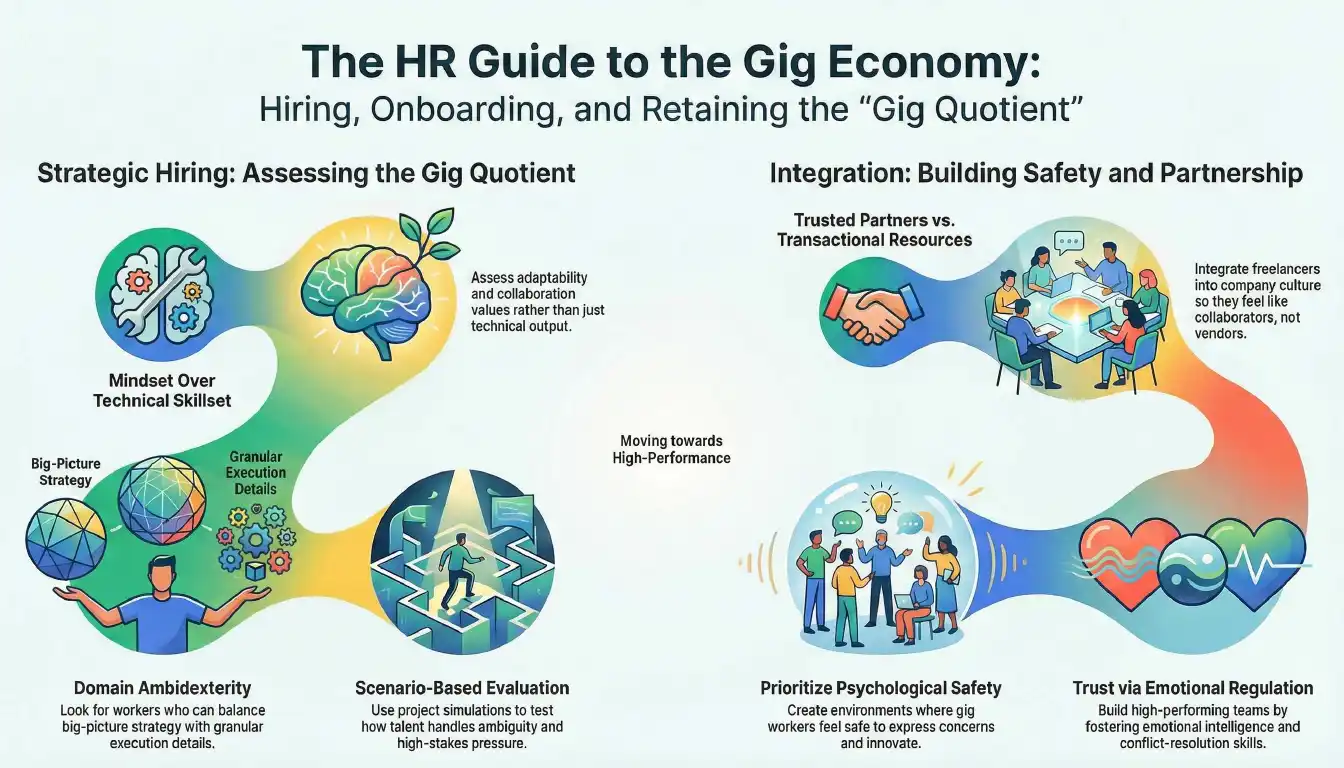
Das and Mookherjee suggest that organizations must pivot from assessing "Job Fit" to assessing "Gig Quotient" (GQ). This framework moves beyond technical output to evaluate three core dimensions: Work, Cognitive, and Value.
1. Assess Adaptability (Cognitive Flexibility)
The gig economy is defined by ambiguity. Projects pivot, budgets are cut, and timelines shrink. You need talent that doesn't just endure change but thrives in it.
HR Takeaway: During interviews, don't just ask about past deliverables. Ask scenario-based questions: "If the project scope changes overnight and resources are cut by 20%, how do you reorganize your week?" You are looking for the mental agility to pivot, not just the skill to execute. Research shows cognitive flexibility is one of the top predictors of success in gig and project-based roles — HBR on managing the gig economy.
2. Assess "Proactive Curiosity"
In a short-term engagement, there is no time for long training periods. You need workers who are self-starters.
HR Takeaway: Hire the candidate who asks questions about your business model, your culture, and the "why" behind the project. A gig worker who only asks about the deadline is a vendor; one who asks about the objective is a partner.
3. Assess Values and Collaboration
Gig workers often work remotely or in hybrid setups, making Integrity and Communication harder to monitor but infinitely more critical.
HR Takeaway: As the authors note, organizations must ask: "Are we hiring for skills alone, or are we also assessing adaptability, values, and collaboration?"
Once you have hired the right talent, how do you treat them? Too often, companies view freelancers as "plug-and-play" resources. They are excluded from team meetings, kept in the dark about company goals, and treated as outsiders.
The book argues that this transactional approach is fatal to quality. To get the best out of gig workers, you must onboard them as Trusted Partners.
1. Integrate, Don’t Isolate
The protagonists, Anita and Rahul, eventually form a production house called EQNL (Equals, Not Leaders). Their philosophy is radical but effective: the hierarchy is flat, and everyone—from the senior editor to the junior researcher—is an equal contributor.
HR Takeaway: Don’t just send a freelancer a Dropbox link and a deadline. Include them in the kickoff. Invite them to the brainstorming session. Create a "Human Knot" moment where they feel physically and intellectually connected to your full-time employees. Best practices for onboarding freelancers emphasize early inclusion — Upwork’s complete freelancer onboarding guide.
2. Transparency Builds Loyalty
Gig workers are often anxious about payment and scope creep. Trust is built through administrative transparency.
HR Takeaway: Ensure your onboarding process includes clear, fair contracts and a transparent payment schedule. When a gig worker knows they will be paid on time and treated fairly, their mental energy shifts from anxiety to creativity.
Perhaps the most profound insight for organizations from GIGglers GIGgling GIGgles is the link between Psychological Safety and Performance.
In the gig economy, workers effectively have zero job security. This precarity can lead to risk-aversion. Why pitch a bold idea if a mistake means losing the contract? To counter this, organizations must actively manufacture safety.
1. Trust Building and Emotion Regulation
The book highlights Emotion Regulation as a critical competency, not just for the worker, but for the leader.
HR Takeaway: When a gig worker falters, pause before you terminate. High-performing gig teams are built on what the authors call "Relational Equity". If you support a freelancer during a personal crisis, you gain a level of commitment that money cannot buy.
2. Support Without Sermons
Micromanagement is the enemy of the gig economy. The goal is autonomy.
HR Takeaway: Shift your management style from "Command and Control" to "Support and Enable." Provide tools, templates, and mentorship. As Anita demonstrates, when you invest in a gig worker’s growth, you get better work in return.
3. Conflict as a Design Tool
Finally, organizations must normalize healthy conflict. In Chapter 13, Rahul establishes rules for "Fighting Fair," emphasizing Data-Driven Decision Making and Active Listening.
HR Takeaway: Make it clear to gig workers that their dissenting opinions are valued. Often, freelancers are the only ones objective enough to tell you the truth about your project. Create a culture where they feel safe to say, "I think this strategy is wrong," without fear of losing the gig. Psychological safety is the single biggest driver of high-performing teams — Google’s Project Aristotle & Amy Edmondson on psychological safety.
Sujitesh Das and Abhinandan Mookherjee’s work serves as a wake-up call. The gig economy is not a race to the bottom for cheaper labor; it is a race to the top for specialized, agile talent.
To win this race, organizations must fundamentally rethink their relationship with the workforce.
As the book poignantly reminds us, "Aliens look for equals, not leaders". If your organization can treat gig workers as equals—investing in their integration and well-being—you won't just get a deliverable. You will get the agility, innovation, and resilience required to navigate the future of work. The World Economic Forum highlights that by 2030, gig and platform work will represent over 30% of the global workforce — organizations that master GQ hiring will lead the way — WEF Future of Work Report 2025.











In today’s rapidly evolving work landscape, the arrival of Agentic AI in the workplace is shifting the way teams function, decisions...

As artificial intelligence continues to reshape the workplace, a new frontier is emerging-one where human workers and AI agents...

The “Future of Work” is no longer a distant vision—it’s today’s reality. In 2025, global organizations are navigating a landscape...

In a world where distributed teams are the norm rather than the exception, the role of culture is under the microscope like never before...

We hear about AI everywhere - from headlines about job losses to promises of supercharged productivity...

In today's dynamic and often unpredictable business landscape, growth is the ultimate aspiration for small and mid-sized enterprises (SMEs)...