
Parenting, Crisis, and the Safety Net of Community


The popular image of the gig economy is often painted in glossy strokes: the digital nomad typing away on a beach in Bali, the high-flying consultant choosing their own hours, or the creative genius working from a sunlit studio. It is a narrative of ultimate freedom and autonomy. But peel back the Instagram filter, and a more complex, gritty, and deeply human reality emerges.
For millions of gig workers, the "hustle" isn’t just about landing the next client or hitting a revenue target. It is about answering a client call while soothing a crying toddler. It is about navigating a personal crisis without paid leave or an HR department to lean on. It is about finding the discipline to work when no one is watching.
In the upcoming book GIGglers GIGgling GIGgles, authors Sujitesh Das and Abhinandan Mookherjee pull back the curtain on this emotional reality. Through the lives of protagonists Anita and Rahul, the book argues that success in the gig economy requires more than just technical skill; it demands a profound mastery of the human element. This isn't just a story about projects; it is a story about people—about how they show up, adapt, and grow in a world that demands flexibility, emotional intelligence, and purpose.
This post explores the "Human Side of the Hustle," diving into three critical areas that define the lived experience of the modern gig worker: the juggling act of parenting, the resilience required when life falls apart, and the quiet power of mentorship.
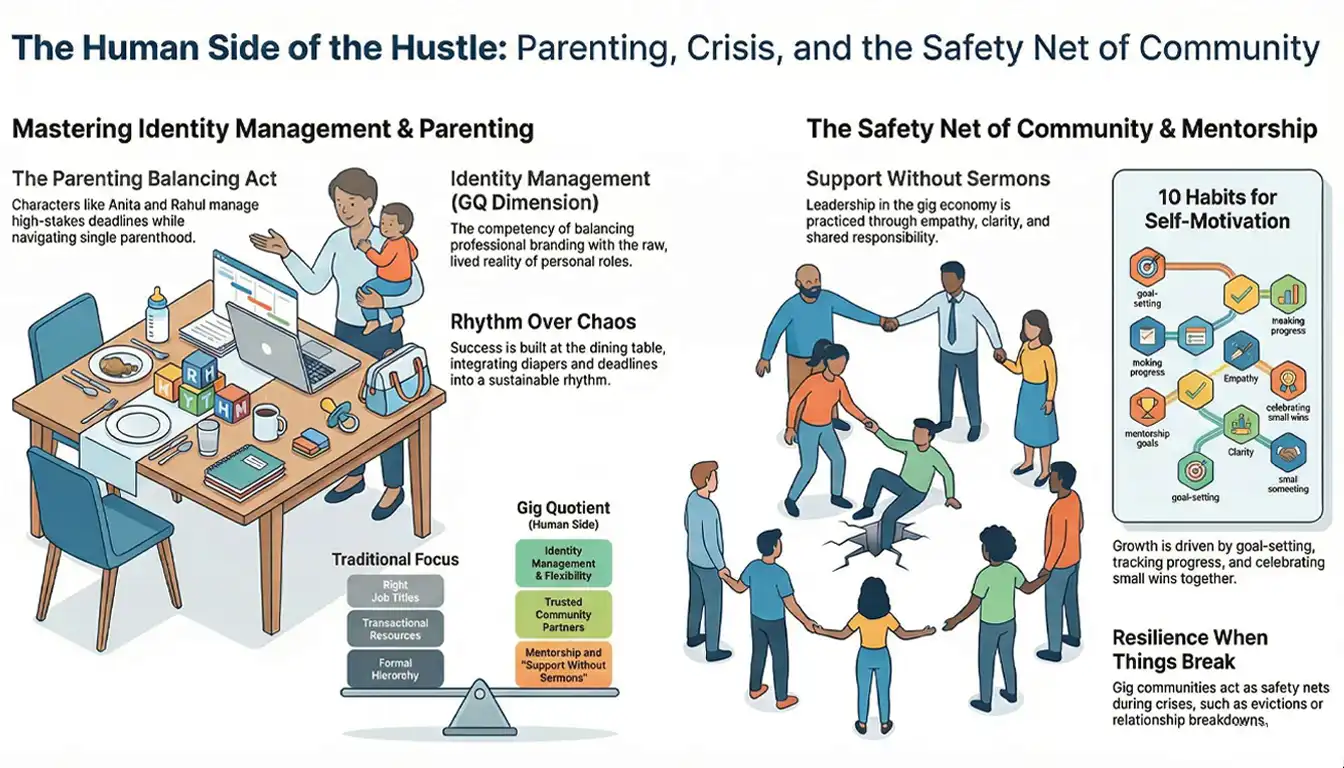
In the traditional corporate world, there is often a physical and psychological separation between "home" and "work." You badge in, you badge out. In the gig economy, those lines are not just blurred; they are erased. Your living room is your conference room, and your work hours are dictated by your child’s nap schedule.
This dynamic requires a specific competency the authors call Identity Management—the ability to seamlessly toggle between the role of a nurturer and the role of a professional without losing your sense of self.
Take Anita, a central character in the book. She is a single mother to a toddler named Mira. Her day doesn't begin with a leisurely coffee and a review of the stock markets; it begins with a chase. Mira runs around the bed dodging spoonfuls of porridge while Anita mentally preps for a 9 a.m. Zoom call. Her workspace is a dining table covered in sticky notes and a half-read parenting book.
Anita chose this life. Facing societal disapproval for her decision to raise a child alone, she packed her bags and built a life on her own terms. But the freedom she gained came with a heavy cognitive load. She has to manage the "Identity Management" of being a fierce, reliable editor to her clients while being a present, loving mother to Mira. There is no switch she can flip. She is often working late into the night, her laptop glowing beside her sleeping daughter.
Then there is Rahul, a documentary filmmaker and single father to a pre-teen named Piku. Rahul’s reality is a masterclass in Cognitive Flexibility. He isn’t just raising a son; he is also the primary caregiver for his aging parents. His mother has Parkinson’s, and his father battles chronic COPD. Rahul’s kitchen is described not as a culinary haven, but as a "medicine vault," stocked with IV fluids and nebulizers alongside Piku’s snacks.
For Rahul, parenting involves more than just school runs; it involves instilling values. He bonds with Piku over tennis, using Roger Federer’s speeches to teach his son about resilience and overcoming hard moments. He is constantly switching gears—from directing a high-stakes shoot to managing his father’s oxygen levels to ensuring Piku finishes his homework.
For both Anita and Rahul, the gig economy offers the flexibility to be present for these moments, but it demands a relentless internal calibration. They don’t have the luxury of "checking out." Their success lies in their ability to integrate these identities rather than compartmentalize them. They prove that you don’t have to hide your parenthood to be a professional; you just have to manage the intersection with grace and grit. As many parents in the gig economy experience, this flexibility comes with trade-offs like income instability and no built-in safety net — see more on the challenges for parents freelancing.
One of the starkest differences between traditional employment and gig work is the absence of a safety net. There is no sick leave, no medical insurance provided by an employer, and no HR department to handle grievances. When personal tragedy strikes, the gig worker is often on their own.
Or are they?
GIGglers GIGgling GIGgles illustrates that in the absence of corporate structures, the community becomes the safety net. This is where the competency of Psychological Resilience transitions from an individual trait to a collective act.
The book poignantly captures this through the story of Amma, Anita’s domestic help and an integral part of her support system. One winter morning, Amma arrives late, minus her usual sparkly "chamkila" bindi that Mira loves to touch. The tension is palpable. Over tea, Amma breaks down: her home in an informal settlement has been bulldozed overnight. She has lost everything—shelter, belongings, security.
In a corporate setting, this might be treated as an unfortunate external event. In Anita’s gig ecosystem, it is a call to action. Anita mobilizes her network—not just to offer sympathy, but to build a solution. She calls lawyer and banker friends to help the displaced women form a cooperative. She turns her living room into a strategy war room, helping them open bank accounts and organize resources. She offers Amma a room in her own home. This response highlights a critical value in the gig economy: Integrity and Trust Building. The relationships formed here are not transactional; they are deeply reciprocal.
We see this again with Ajit, a senior cameraman on Rahul’s team. During a critical shoot in Lucknow, Ajit arrives late and distracted, jeopardizing a project involving special needs children. A traditional boss might have fired him for unprofessionalism. But Rahul, utilizing high Emotion Regulation, digs deeper.
He discovers that Ajit is facing a personal crisis—his long-term partner has left him, and he is facing homelessness. Instead of issuing a termination letter, Rahul activates his "hustle crew." He tasks his assistants, Nisha and Anmol, with finding Ajit a place to stay. "We’ll find you a new adda, boss," Anmol promises.
This is the human side of the hustle. It is the understanding that when a colleague falls, you don't step over them; you pick them up. Resilience in this world isn't just about "toughing it out" alone; it's about the "Human Knot" of support where people hold on to each other to survive the chaos. Gig work often correlates with higher stress due to instability, but community support can buffer it — research shows approach coping and social support reduce stress in gig workers. In India, statistics highlight the gap: over 77% of platform workers lack formal social security.
If community is the safety net, then mentorship is the ladder.
In the gig economy, there are no formal training programs or designated career paths. Growth happens through observation and guidance from those a few steps ahead. The book shines a light on this through Anita’s relationship with her younger writers, Srija and Akhila.
Anita notices that despite their talent, the two young women are slipping. Missed deadlines and low energy are becoming frequent. Instead of a formal performance review or a stern warning, Anita opts for a "Support without Sermons" approach. She invites them over for chai and realizes they lack the structures for self-motivation.
Anita understands that Identity Management and Time Management are learned skills. She opens up her "Columbia Notes"—lessons she learned during her own struggles—and shares a practical toolkit with them. She teaches them specific habits:
This interaction transforms their relationship. Anita shifts from being a "boss" to being a mentor. She creates a psychological safe space where Srija and Akhila can admit their struggles without fear of losing their income. By sharing her own vulnerabilities and the habits that keep her grounded, Anita empowers them to take ownership of their careers.
This mentorship is crucial because gig work can be isolating. Without a water cooler to gather around, knowledge transfer has to be intentional. Anita shows that mentorship in the gig economy isn't about top-down instruction; it's about side-by-side growth. It is about saying, "I've been where you are, and here is the map." Mentoring helps freelancers build skills and networks — see how gig economy mentoring supports freelancing success.
Ultimately, Theme 3 of the blog series brings us back to the core message of GIGglers GIGgling GIGgles: The Gig Quotient (GQ) is not just a measure of professional competence; it is a measure of human capacity.
The framework’s three dimensions—Work, Cognitive, and Value—are not abstract concepts. They are lived realities.
The gig economy is often criticized for being precarious and demanding. And it is. But as these stories reveal, it is also a space of profound connection, resilience, and humanity. It is a world where colleagues become family, where diversity is a strength, and where success is defined not just by what you build, but by who you lift up along the way.
For organizations looking to hire gig workers, and for individuals looking to join this workforce, the lesson is clear: Don’t just look for skills. Look for the heart. Look for the resilience. Look for the GQ. Because when the deadline looms and the pressure mounts, it is the human side of the hustle that will see you through.






Organizations operating in distributed, high-volume, or high-variability environments, such as HR shared services...

As the digital landscape evolves, data-powered organizations are gaining a competitive edge. Data has become the new currency...

The world of work is evolving at an unprecedented pace, and outplacement and workforce transition consulting...

The workplace is rapidly evolving at an unprecedented pace. As organizations navigate a landscape increasingly influenced by artificial intelligence...

Artificial Intelligence (AI) isn’t just some sci-fi fantasy anymore—it’s really changing the way companies work today...

In today’s fast-paced business world, People Analytics is reshaping the way organizations attract, engage, and retain talent...